
The Silent Threat in Your Home: Why CO Detectors and Heat Exchanger Inspections Aren't Optional
As winter settles over Traverse City, we naturally retreat indoors. We seal our windows, install weather stripping, and rely heavily on our heating systems to keep the freezing Michigan temperatures at bay.
While a tightly sealed home is excellent for energy efficiency, it creates a potential trap. If your heating system malfunctions, that same airtight seal prevents dangerous gases from escaping.
At Grant Mechanical, we often talk about comfort, but today we need to talk about survival. Carbon Monoxide (CO) is a serious threat to families in our region, and understanding the relationship between your furnace’s heat exchanger and your CO detectors is a matter of life and safety.
The Invisible Enemy: Carbon Monoxide
Carbon Monoxide is odorless, colorless, and tasteless. You cannot detect it without technology. In the HVAC industry, we call it the “Silent Killer” because it strikes without warning.
In a properly functioning furnace, the combustion gases (including CO) are safely vented outside your home. However, when the system is compromised, those gases can leak into your living space. In a drafty, older house, you might get lucky with some natural ventilation. In a modern, energy-efficient home, there is nowhere for the gas to go but into your lungs.
Symptoms of CO poisoning often mimic the flu—a common confusion during winter months:
- Headaches
- Dizziness and weakness
- Nausea or vomiting
- Chest pain
- Confusion
If your entire family (and even pets) begin feeling these symptoms simultaneously while at home, evacuate immediately and call emergency services.
The Root Cause: The Cracked Heat Exchanger
The heart of your gas furnace is a component called the heat exchanger. This metal chamber is where the combustion process happens. It is the physical barrier that separates the toxic burning gases from the clean, warm air that is blown into your bedrooms and living areas.
How does it fail? Over time, the metal of the heat exchanger expands and contracts thousands of times as it heats up and cools down. This thermal stress can eventually cause cracks in the metal.
Once a crack forms, the barrier is broken. When your furnace blower turns on, it can disturb the pressure balance, pulling toxic exhaust gases—including Carbon Monoxide—out of the exchanger and pushing them through your ductwork.
A cracked heat exchanger is not a “minor repair” issue; it is a critical safety failure.
Your First Line of Defense: Carbon Monoxide Detectors
If you do not have Carbon Monoxide detectors installed in your home, please stop reading this and go purchase them immediately.
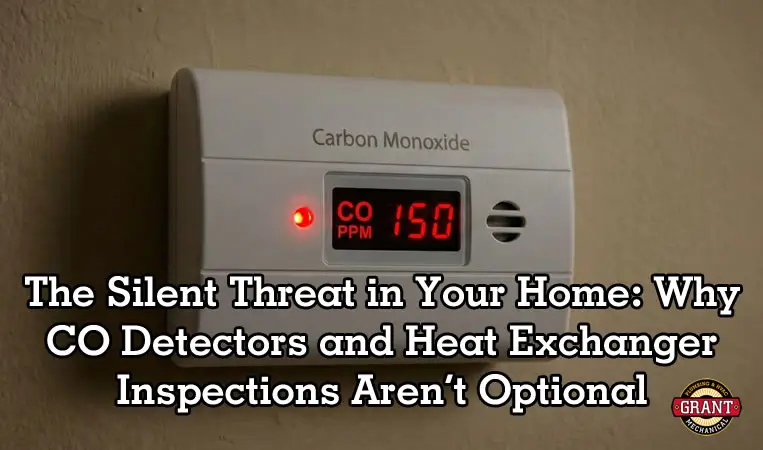
Detectors are your only warning system. However, owning them is not enough; they must be maintained.
- Placement Matters: You should have a detector on every level of your home and outside every sleeping area.
- Expiration Dates: CO detectors have a lifespan (usually 5 to 7 years). If yours is yellowing or old, replace it.
- Regular Testing: Test the batteries monthly.
Your Best Prevention: Annual Inspections
While a CO detector is essential, it is a reactive device. It only alerts you after the dangerous gas is already present in your home.
The goal should be prevention. This is why annual furnace maintenance is not just about keeping your utility bills low—it is a safety inspection.
When Grant Mechanical performs a seasonal inspection, checking the integrity of the heat exchanger is a top priority. We use specialized tools, such as combustion analyzers and inspection cameras, to identify hairline cracks or corrosion that the naked eye might miss.
We catch the problem before it becomes a leak.
Protect Your Family This Winter
In the depth of a Traverse City winter, your furnace is running for hours every day. Do not take its safety for granted.
If you have not had your furnace inspected this season, or if you are unsure about the age and condition of your CO detectors, please act now. The safety of your family is too important to leave to chance.
Contact Grant Mechanical today to schedule your safety inspection. Let us ensure that the air circulating in your home is as safe as it is warm.