

Keeping Cool Upstairs: Balancing Two-Story Homes
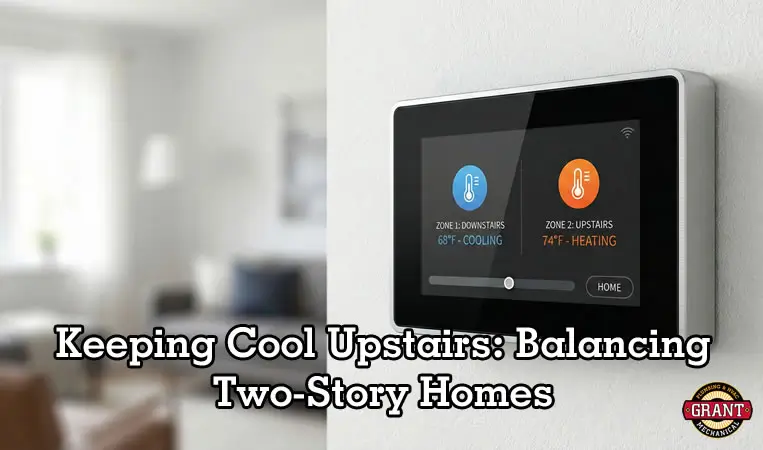
If you live in a two-story home in Traverse City, you are likely familiar with a frustrating phenomenon that arrives every summer. You’re enjoying a pleasant, cool afternoon in your living room, but the moment you walk up the stairs to go to bed, you hit an invisible wall of heat.
The “hot upstairs, cold downstairs” struggle is one of the most common complaints we hear from homeowners during Michigan summers. It forces your air conditioner to work overtime, drives up energy bills, and makes sleeping comfortably a challenge.
The good news? You don’t have to suffer through humid nights or freeze out your first floor just to cool the second. Here is why this happens and three practical solutions to balance your home’s temperature.
Why is My Upstairs So Hot?
Before we fix it, it helps to understand the physics at play. There are usually three main culprits:
- Heat Rises (The Stack Effect): Hot air is less dense than cold air, so it naturally ascends to the highest point in your home.
- Roof Heat Gain: Your roof absorbs the sun’s energy all day, radiating that heat directly into your attic and the rooms below it.
- Ductwork Issues: In many homes, the ductwork leading upstairs is longer and has more turns, reducing airflow pressure by the time it reaches the second floor.
Here is how you can fight back against the heat.
1. The Quick Switch: Adjust Your Fan Setting
This is the simplest trick in the book, and it doesn’t cost a dime in equipment. Most homeowners leave their thermostat fan setting on “Auto.” This means the blower fan only runs when the air conditioner is actively cooling the house. When the AC turns off, the air stops moving, allowing hot air to pool upstairs immediately.
Try switching your fan setting from “Auto” to “On.”
By keeping the fan running continuously (even when the AC compressor isn’t cooling), you constantly circulate air throughout the house. This mixes the cool air from the downstairs with the hot air upstairs, creating a more even temperature throughout the home. While this does use a little more electricity for the fan, it often reduces the load on your AC unit because the system doesn’t have to work as hard to tackle massive temperature spikes.
2. The Envelope Check: Insulation and Attic Ventilation
If your upstairs feels like a sauna, your attic might be to blame. In Northern Michigan, we often think of insulation as a way to keep heat in during the winter, but it is just as vital for keeping heat out during the summer.
If your attic insulation is thin or settled, the heat accumulating in your attic (which can reach 140°F or more on a sunny July day) will transfer right through the ceiling into your bedrooms.
Additionally, proper attic ventilation is key. Soffit vents and ridge vents allow that super-heated air to escape. If these are blocked or insufficient, the heat stays trapped, baking your second floor. Having a professional assess your attic’s “thermal envelope” can make a massive difference in year-round comfort.
3. The Ultimate Solution: HVAC Zoning
If you want precise control, an HVAC Zoning System is the gold standard.
Standard HVAC systems treat the entire house as one single zone, usually controlled by a single thermostat located on the first floor. When the downstairs reaches the target temperature, the system shuts off—regardless of how hot it is upstairs.
Zoning solves this by using motorized dampers inside your ductwork and placing separate thermostats on each floor. This allows you to direct cool air exactly where it is needed.
- Scenario: At night, you can set the system to prioritize cooling the upstairs bedrooms while letting the unoccupied downstairs stay a few degrees warmer.
This not only solves the comfort issue but creates significant energy efficiency, as you aren’t paying to cool unused areas of your home.
Summary: Small Steps for Better Sleep
You shouldn’t have to sleep in the living room just to stay cool this summer. Whether you start by simply flipping your fan switch or decide it’s time to invest in a zoning system, balancing your home is possible.
Quick Tips to Help Right Now:
- Close blinds and curtains on south and west-facing windows during the day.
- Ensure upstairs return vents are not blocked by furniture or rugs.
- Switch to LED light bulbs, which produce far less heat than incandescent bulbs.
Ready to Balance Your Home?
If you are tired of the battle between the floors, let the team at Grant Mechanical take a look. We can inspect your ductwork, evaluate your insulation, or discuss if a zoning system is the right fit for your Traverse City home.

