
DIY vs. Pro: What You Can (and Can’t) Fix on Your AC
When the mid-summer heat hits Traverse City, the last thing you want is for your air conditioner to quit. When it does, the temptation to open the toolbox and try a “quick fix” to save money is understandable. We love the DIY spirit—many of our neighbors here in Northern Michigan are incredibly handy!
However, modern HVAC systems are complex machines involving high-voltage electricity, high-pressure gases, and delicate calibration. There is a fine line between helpful maintenance and dangerous tinkering.
At Grant Mechanical, your safety is our top priority. Before you unscrew that service panel, let’s look at what is safe for you to handle and what absolutely requires a certified professional.
The Green Light: Safe DIY Maintenance
There are several things you can (and should) do to keep your AC running efficiently. These tasks don’t involve opening the internal components of the machine but are vital for longevity.
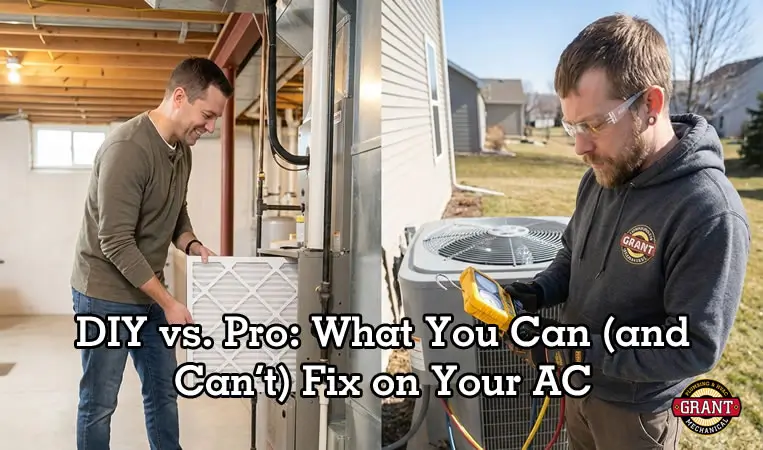
- Changing the Air Filter: This is the #1 DIY task for any homeowner. A clogged filter restricts airflow, forcing your system to work harder and potentially freeze up. Check your filter every 30 to 90 days. If it’s gray and dusty, swap it out. It’s safe, easy, and saves you money on energy bills.
- Clearing Debris: Go outside to your condenser unit (the big box with the fan). Over the seasons, it can get crowded by tall grass, falling leaves, or twigs. Ensure there is at least two feet of clearance around the unit so it can “breathe.”
- Checking the Thermostat: Sometimes the issue isn’t the AC; it’s the batteries in your thermostat. Changing old batteries and ensuring the settings are correct (set to “Cool” and “Auto”) is a perfectly safe troubleshooting step.
- Inspecting (Not Fixing) the Drain Line: If you see water pooling around your indoor unit, your condensate drain line might be clogged. You can visually inspect the exit point of the pipe outside to see if it’s dripping, but if the clog is deep in the system, it’s often safer to call a pro to clear it without damaging the PVC.
The Red Light: When to Call Grant Mechanical
There are specific areas of your air conditioner that are genuinely dangerous for untrained individuals. If the problem goes beyond a dirty filter or a thermostat setting, it’s time to put the tools down.
- Refrigerant Issues If your AC is blowing warm air or ice is forming on the coils, you might be low on refrigerant (often referred to as Freon or Puron).
- The Danger: You cannot simply “top off” refrigerant like you do oil in a car. It is a closed loop system; if it’s low, there is a leak. Refrigerant can cause chemical burns and respiratory issues if mishandled. Furthermore, handling refrigerant requires EPA certification by law.
- The Pro Fix: We locate the leak, repair it, and recharge the system to the precise manufacturer specifications.
- Electrical Components (Capacitors and Wiring) AC units use huge amounts of power.
- The Danger: Even if you turn the power off at the breaker, components like the capacitor act like a battery—they store a high-voltage charge that can deliver a serious, or even fatal, shock. Never attempt to replace a capacitor or splice internal wires yourself.
- The Pro Fix: Our technicians are trained to safely discharge these components and manage high-voltage connections without risk of fire or injury.
- The Fan Motor and Compressor If you hear grinding, squealing, or clicking noises, these are mechanical failures. Attempting to disassemble the motor or compressor can permanently destroy your unit and void your manufacturer’s warranty.
Safety First, Always
We understand the desire to fix things yourself, but the risks associated with HVAC repair—electrical shock, chemical exposure, and voided warranties—aren’t worth the gamble.
The best way to “DIY” your air conditioner is to keep it clean and schedule regular professional maintenance. Let us handle the high voltage and the pressure gauges so you can stay safe and cool.
Need a hand with your AC? Grant Mechanical is Traverse City’s trusted team for safe, reliable HVAC repair.